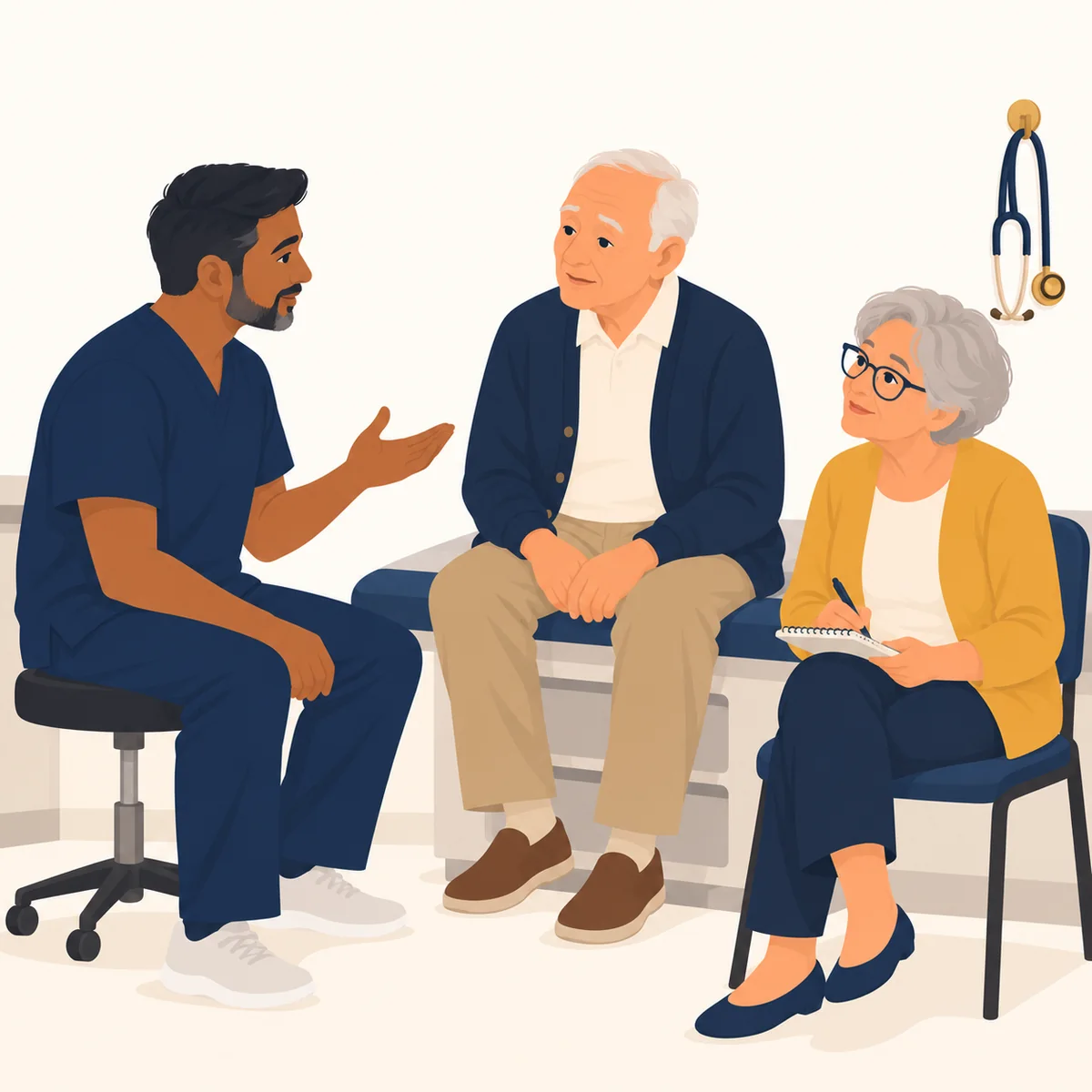
Evelyn is 70. Her husband, Ray, is 73. He had a stroke last spring. Now Evelyn drives him to every visit. She sits in the chair by the wall. She tries to write it all down.
Last month the doctor talked fast. Blood thinner. Swallow test. Physical therapy twice a week. A new pill for blood pressure. Evelyn wrote "blood" and "test" and "Tuesday" and then lost the thread. In the car Ray asked, "What did he say about the dizzy spells?" She did not know. Neither did he.
That night she lay awake trying to remember. She has her own doctor visits, too. She has not been to one since spring.
Names and details are made up. This is not a real patient. But if your spouse's care has become your second job, this is for you.
Why this happens
Caring for a husband or wife is different from caring for a parent. You are not a visitor. You live inside it, every day, and you are often not young either. Two people in the room does not mean two good memories. Everyone forgets 40 to 80 percent of what the doctor said right away. (Kessels, 2003)
And the care goes one way. In a national study, nearly one in four caregivers said it was hard to take care of their own health. (AARP and National Alliance for Caregiving, 2020)
What you can do
- Stop trying to write it all. Ask the doctor to write down the three things that matter: what changed, what to do, when to come back.
- Ask one question at the end. "What is the one thing we must not miss?" Then write that one down.
- Ask if you can record. Then neither of you has to carry it in your head. You can go over what was said together at home.
- Keep two lists, one for each of you. His medicines on one sheet with his name on top. Yours on another sheet with your name on top. Two people's pills on one list get mixed up, the same way two people's bottles in one bag do.
- Keep your own appointments. You cannot drive him if you are the one in the hospital. Put your visits on the same calendar as his.
How Keeybod helps
After Ray asks the doctor, Keeybod records the visit and gives him an easy-to-read summary on his phone, with his medicines and next steps. He can share it with Evelyn, so they both have the same words. It is free during the pilot.
By Dr. Jim Besong, family medicine doctor. This is general information, not medical advice. Ask your own doctor about your care.
About the author
Dr. Jim Besong is a family medicine doctor in Florida and a U.S. Marine veteran. He started Keeybod so patients can remember and understand what their doctor said.
Join the pilot list